Signed in as:
filler@godaddy.com
A Complete Guide for Retail Shopping Center Investors
September 2, 2026

A feasibility study is not slow because consultants are inefficient—it is slow because the methodology requires original, defensible research rather than off-the-shelf conclusions.
For retail shopping centers, consultants typically integrate Census and American Community Survey (ACS) demographic data, Esri-grade drive-time analysis, state DOT traffic counts, state retail sales tax information (where available)[1], GIS mapping[2], and a category-level competitive inventory[3] to understand the property's trade area[4] and market dynamics. Those findings are supplemented with field observations, interviews, surveys or focus groups (when appropriate), and custom financial modeling[5] designed to withstand lender, investor, and investment committee scrutiny.
Rent conclusions are likewise developed through independent market benchmarking and tenant economics rather than relying solely on asking rents or seller representations. Consultants must reconcile conflicting data sources, validate assumptions, conduct site visits, and build a lender-defensible analytical model before issuing their conclusions. These sequential tasks explain why even boutique consulting firms with expedited processes typically require two to four weeks, while comprehensive feasibility studies commonly require two to six weeks to complete.
The time associated with this level of analysis is entirely appropriate when a project has advanced to formal due diligence. The challenge is that many acquisition opportunities can—and should—be eliminated long before a full feasibility study becomes justified. That gap is precisely where Commercial Real Estate Feasibility Screening provides value.
[1] Wert-Berater, Inc., "Retail & Shopping Center Feasibility Studies," https://www.wert-berater.com/services/retail-feasibility-study.html, Accessed August 6, 2026.
[2] Clyde C. Anderson, “GIS for Retail: How Location Data Drives Growth,” GrowthFactor, https://www.growthfactor.ai/resources/blog/gis-for-retail, February 14, 2026.
[3] Wert-Berater, Inc., "Retail & Shopping Center Feasibility Studies," https://www.wert-berater.com/services/retail-feasibility-study.html, Accessed August 6, 2026.
[4] SafeGraph Editorial Team, "7 Benefits of Trade Area Analysis for Smarter Location Decisions," SafeGraph, https://www.safegraph.com/blog/benefits-of-trade-area-analysis/, July 15, 2026.
[5] Scribd Inc., “Economic Feasibility Study Guide,” Accessed August 4, 2026.

For investors evaluating retail shopping centers, a traditional feasibility study typically costs between $10,000 and $25,000[1], depending on the size, complexity, and scope of the engagement. These studies generally include primary and secondary market research, detailed competitive analysis, demand forecasting, financial modeling, sensitivity testing, and risk analysis.
More complex commercial real estate developments can require substantially broader analyses and can range from $15,000 to $50,000[2], with especially large or highly regulated developments reaching $50,000 to more than $200,000[3].
Some firms also offer pre-feasibility or screening studies, which typically range from $5,000 to $15,000 depending on the scope of work[4]. While these engagements provide a more economical alternative to a comprehensive feasibility study, they generally are substantially more limited than a full lender-grade feasibility report.
Across the industry, a useful rule of thumb is that feasibility study budgets often range from approximately 0.75% to 3% of total project cost[5]. Ultimately, the required level of analysis depends on the intended audience. A report prepared solely for an investor's internal decision-making can often be more narrowly scoped than one intended to withstand the scrutiny of lenders, equity partners, or investment committees.
------------------------------
[1] Alex Silensky, “How to Choose a Feasibility Study Consultant,” OGS Capital, https://ogscapital.com/article/choose-a-feasibility-study-consultant/, January 8, 2026.
[2] Bristola, “How Much Does a Feasibility Study Cost? Complete Guide,” https://bristola2.com/feeds/blog/feasibility-study-cost, May 18, 2026.
[3] Alex Silensky, “How to Choose a Feasibility Study Consultant,” OGS Capital, https://ogscapital.com/article/choose-a-feasibility-study-consultant/, January 8, 2026.
[4] Bristola, “How Much Does a Feasibility Study Cost? Complete Guide,” https://bristola2.com/feeds/blog/feasibility-study-cost, May 18, 2026.
[5] Bristola, “How Much Does a Feasibility Study Cost? Complete Guide,” https://bristola2.com/feeds/blog/feasibility-study-cost, May 18, 2026.

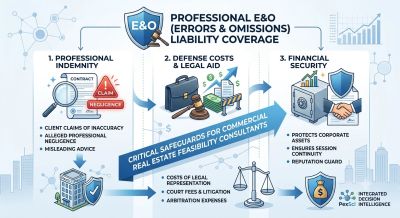
Given the significant financial investment required, understanding how institutional stakeholders utilize a full feasibility study clarifies why it commands such an exhaustive scope. A CRE feasibility study is a comprehensive analysis that assesses the potential success of a real estate project, as well as surfaces local regulations, zoning laws, environmental issues, and the needs of the community. It is also conducted to guide investment decisions concerning the project.[1] Lenders use it to underwrite debt; investment committees (IC) use it to approve or reject capital allocation;[2] government agencies use it to evaluate public-private partnerships;[3] developers use it to secure equity partners[4]; and REITs use it to evaluate the viability of potential acquisitions or development opportunities within their portfolios.[5] A study is mandatory for USDA Business and Industry (B&I) guaranteed loans exceeding $1 million, under 7 CFR § 5001.306(a)(3)(i), which is commonly used in commercial real estate projects.[6] Because third parties rely on the report's conclusions to commit real money, the consulting firm that produces it assumes direct professional exposure to third-party reliance claims.
The legal exposure associated with a full feasibility study typically arises as a claim of professional negligence: a consultant who breaches the duty of reasonable skill and care—whether through a flawed market projection or a mis-modeled rent roll — may be held liable if a lender or investor relies on those conclusions and suffers a loss as a result.[7,8] This is a well-established category of legal claim against transaction professionals, including appraisers, surveyors, and accountants—and feasibility consultants face the same exposure when a client acts on a flawed recommendation.[9] Firms preparing studies for regulated lending programs, such as SBA 7(a)/504 or USDA Business and Industry loans, work under explicit governance frameworks: engagements follow USPAP disciplines and align with SBA SOP 50 10 8 and USDA 7 CFR Part 5001 requirements to ensure the methodology meets formal professional standards.[10]
Conversely, a feasibility screening report intentionally operates outside these regulated appraisal standards. It does not provide certified opinions of value under USPAP, nor does it conduct environmental site assessments, municipal zoning verifications, or engineering inspections. Its legal risk profile is designed to eliminate reliance liability by explicitly establishing that the document is non-directive, non-binding, and meant solely for internal screening rather than third-party capital underwriting.


Community, neighborhood, and strip centers generally range from less than 30,000 to approximately 350,000 square feet, as classified by CoStar. Feasibility screening delivers outsized value across this segment for reasons specific to how these assets perform in the market.
Unlike single-tenant net-lease assets, multi-tenant retail centers derive their value from a portfolio of tenants, which means risk is distributed across leases with different credit profiles—and multi-tenant centers also have interdependent income streams.[1] This matters acutely for community and neighborhood centers, which typically depend on a grocery store, pharmacy, or discount retailer to drive foot traffic to the smaller in-line shops around it. If that anchor relationship is fragile—an aging lease, a struggling operator, or a demographic shift eroding the anchor's sales base—the entire center's economics are at risk.
Compounding this, retail leases frequently contain co-tenancy provisions: if an anchor vacates or downsizes, inline tenants may gain contractual rights to pay reduced rent or terminate early.[2] When lease summaries or relevant lease information are available, feasibility screening can flag disclosed co-tenancy provisions and identify where further lease review is required before capital is committed.
Strip centers present a related but distinct challenge: smaller footprints, thinner tenant rosters, and a heavier reliance on local, non-credit tenants whose businesses are more exposed to local economic swings. With fewer tenants, the loss of one occupant can remove a disproportionate share of rent and materially alter the center's merchandising mix. For an investor evaluating several strip center opportunities in a market at once—a common scenario for private buyers and smaller REITs building a regional portfolio—feasibility screening allows rapid comparative evaluation across candidate properties, surfacing which centers have durable trade-area support and which are propped up by temporarily strong but fragile tenancy.
------------------------------
[1] Westwood Net Lease Advisors, "Pros and Cons of Single-Tenant vs. Mulli-Tenant Properties," https://westwoodnetlease.com/pros-and-cons-of-single-tenant-vs-multi-tenant-properties/, April 14, 2022.
[2] Mohr Partners, "Co-Tenancy Clauses in 2025: A Tenant Safety Net or a Landlord's Risk Factor?," https://mohrpartners.com/global-lease-serv-bl/co-tenancy-clauses-in-2025-a-tenant-safety-net-or-a-landlords-risk-factor/, July 24, 2025.
Not every center's demand driver sits within its own four walls. Many neighborhood and strip centers may derive a substantial share of their foot traffic from a shadow anchor—a large-format retailer such as a grocery chain, big-box store, or club store that sits on an adjacent, separately-owned parcel rather than inside the subject property itself.[1] Because the investor has no lease with, or control over, the shadow anchor, the center's value depends on a tenant relationship it doesn't actually own. A feasibility screening identifies shadow anchor dependency explicitly—flagging cases where a center's traffic and sales performance would be vulnerable to the shadow anchor's closure, relocation, downsizing, rebranding, or declining customer draw.
------------------------------
[1] Nathan Smith, " What is a Shadow Anchor Store in Retail," Austin Tenant Advisors, https://www.austintenantadvisors.com/blog/what-is-a-shadow-anchor-store-in-retail/, August 22, 2024.
Retail leakage occurs when residents of a trade area spend more on a retail category than local businesses capture.[1] It can result from insufficient local supply, but it may also reflect weaker local offerings, stronger competing destinations, commuting patterns, e-commerce, or consumer preference. Retail leakage is therefore often treated as an early signal that a trade area could support additional supply in that category—though, as discussed below, it is only one input among several needed to reach that conclusion.
A retail surplus indicates that businesses within the trade area capture more category spending than resident demand alone would predict.[2] This may signal a successful retail destination that attracts shoppers from outside the trade area, but it may also indicate a dense concentration of competing retailers, requiring closer analysis of whether the market can sustainably support all existing operators.
Together, retail leakage and retail surplus describe the retail gap—the difference between a trade area's retail potential, or estimated retail demand, and the retail sales currently captured within that market.[3] While retail leakage and surplus provide valuable derived indicators of market demand and supply dynamics, they do not by themselves determine whether a market can support additional retail positioning. A comprehensive feasibility screening should therefore evaluate these indicators alongside the underlying drivers of market demand, including population, household income, employment, household expenditure capacity, traffic patterns, and regional demand generators—major employers or destinations, such as entertainment venues or government centers that attract people into a trade area. It should also evaluate market supply, including the quantity, composition, utilization, and future pipeline of retail space, as well as the subject property's competitive position, including competing shopping centers, tenant mix, rent positioning, accessibility, visibility, and other competitive characteristics. These evidence streams provide a more reliable assessment of market support than any single metric in isolation.
Defining the appropriate trade area is fundamental to that analysis because the geographic boundary determines which consumers, spending capacity, retail supply, and competitors are included in the assessment. Traditional trade-area analysis has often relied on one-, three-, and five-mile radius rings around a subject property. Modern retail site analysis increasingly uses network-based drive-time trade areas—commonly 5-, 10-, and 15-minute polygons—to provide a more realistic representation of the market accessible to a shopping center.[4] Unlike fixed-radius rings, drive-time polygons follow the transportation network and account for the practical accessibility of a site, recognizing that highways, rivers, rail lines, road configurations, congestion, and other physical barriers can materially alter how quickly consumers can reach a property.[5]
For retail feasibility screening, tiered drive-time areas provide a particularly useful framework because each band examines the same fundamental market variables from a progressively broader customer and competitive perspective. The 5-minute band characterizes the property's most immediately accessible market and is particularly informative about convenience-oriented and frequent-trip retail demand. The 10-minute band expands the analysis to the broader customer base from which many neighborhood and community shopping centers may draw recurring shoppers, while capturing additional households, purchasing capacity, consumer segments, retail supply, and a wider field of competing shopping centers and retail alternatives. The 15-minute band extends the analysis to the property's broader market reach, capturing additional sources of consumer demand as well as more distant and destination-oriented competition that may strengthen or constrain the property's draw. Enriching each trade area with demographic, socioeconomic, consumer-behavior, and retail-market data allows the analyst to examine not only how the accessible population grows with travel time, but how its composition, purchasing capacity, retail alternatives, and competitive environment change across the three catchments—and whether those conditions appear aligned with the subject property's retail positioning. However, even a trade area with ideal demographic growth and strong expenditure capacity may not compensate for severe site-level physical impairments.
------------------------------
[1] Buxton, “Retail Leakage and Surplus Analysis,”
https://www.cityofwildwood.com/DocumentCenter/View/4123/Wildwood_Lkg?bidId=#:~:text=Understanding%20Retail%20Leakage,for%20that%20type%20of%20business, Accessed August 6, 2026.
[2] Ibid.
[3] Applied Geographic Solutions (AGS), "Retail Gap & Retail Potential, Reimagined (Again)," https://appliedgeographic.com/2026/04/09/retail-gap-retail-potential-reimagined-again/, April 9, 2026.
[4]ScoutSpace, “How to Use Drive-Time Analysis in Retail Site Selection,” https://www.scoutspace.io/blog-posts/drive-time-analysis-retail-site-selection, July 5, 2026.
[5]Geod, “Trade Area Analysis for Retail Site Selection,” https://www.geod.app/blog/trade-area-analysis, Accessed August 5, 2026.
Retail sales can be influenced by whether a business can be readily seen and accessed as consumers approach a property.[1] Two centers with similar trade-area demographics may perform very differently in part because one benefits from stronger roadway visibility, more readily identifiable access points, favorable turning movements, traffic-signal positioning, or better-configured curb cuts.
If consumers cannot conveniently enter or exit a center during peak traffic periods—including the evening commute, an important retail period for many neighborhood-serving centers—access constraints may adversely affect customer visitation, tenant sales, and, over time, tenant retention. Visibility is similarly affected by physical conditions that may not be apparent from demographic, rent, or other conventional market data alone. These include building orientation relative to the roadway, unobstructed lines of sight from approaching traffic, road curvature, grade changes, vegetation, adjacent improvements, and the exposure and legibility of pylon and building signage. Street-level imagery and mapping tools can extend desktop screening beyond traditional market data by revealing apparent visibility and access constraints that warrant closer investigation.
Feasibility screening can therefore incorporate visual and spatial site review to identify observable conditions that may affect a property's visibility and accessibility. Although street-level imagery cannot substitute for an on-site inspection or independently establish the economic impact of an observed condition, it can identify potential risks for further due diligence and consideration as part of the overall acquisition assessment.
------------------------------
[1] Clyde Christian Anderson, "Retail Store Site Selection: Choose Locations That Win," GrowthFactor, https://www.growthfactor.ai/resources/blog/retail-store-site-selection, June 1, 2025.
Asking rent alone does not reveal whether a tenant can sustainably afford its occupancy cost, which—depending on lease structure—may include base rent, CAM charges, real estate taxes, insurance, utilities, janitorial costs, and amortized tenant-improvement costs[1]. Tenant sales productivity, generally measured as annual sales per leased square foot, is one of the strongest indicators of a retailer's ability to sustain occupancy over time. Closely related is the occupancy cost ratio—the percentage of tenant sales consumed by rent and other occupancy costs [2]— which helps evaluate whether a property's occupancy costs appear economically sustainable relative to expected tenant sales[3]. Because verified tenant sales are rarely available for independent confirmation, screening typically relies on demographic demand, competitive density, market rent trends, occupancy history, and tenant mix as useful, if not definitive, indicators of sustainability.
------------------------------
[1] The Appraisal Institute, “The Dictionary of Real Estate Appraisal, 6th Edition,” p. 161.
[2] McKinsey, “Boosting Mall Revenues Through Advanced Analytics,” https://www.mckinsey.com/industries/retail/our-insights/boosting-mall-revenues-through-advanced-analytics?utm_source=chatgpt.com, January 18, 2019.
[3] Ibid.
For some aging community, neighborhood, and strip shopping centers, the investment thesis may depend primarily on redevelopment, substantial repositioning, or conversion to an alternative use rather than continued operation of the property in its existing form.[1, 2] Such opportunities present a fundamentally different analytical question from evaluating whether the market, property, tenant, and occupancy economics support continued use of the existing retail shopping center.
A feasibility screening designed to evaluate the property's existing use should therefore not be relied upon to assess redevelopment or adaptive reuse potential. Publicly available zoning, land-use, site, or market information encountered during screening may reveal conditions that warrant separate investigation, but the screening itself does not determine whether redevelopment or adaptive reuse is legally permissible, physically feasible, economically viable, or likely to receive required entitlements. Where redevelopment or adaptive reuse is central to the acquisition thesis, the property requires a different, project-specific analytical framework designed for that purpose.
------------------------------
[1] Nothmarq, "From Empty Spaces to Profitable Places: The Role of Adaptive Reuse in Addressing CRE Vacancy Challenges," https://www.northmarq.com/insights/research/empty-spaces-profitable-places-role-adaptive-reuse-addressing-cre-vacancy, July 15, 2025.
[2] West Hive Capital, "Adaptive Reuse Retail Centers: A New Era of Shopping," https://westhivecapital.com/adaptive-reuse-retail-centers/, Accessed September 1, 2026.